From a hotel to a paper company: one operational layer
A boutique hotel and a regional paper-and-print company share almost nothing. Different buildings, different systems, different customers. But the shape of running them is identical, and that shape is what Fibric is built on.
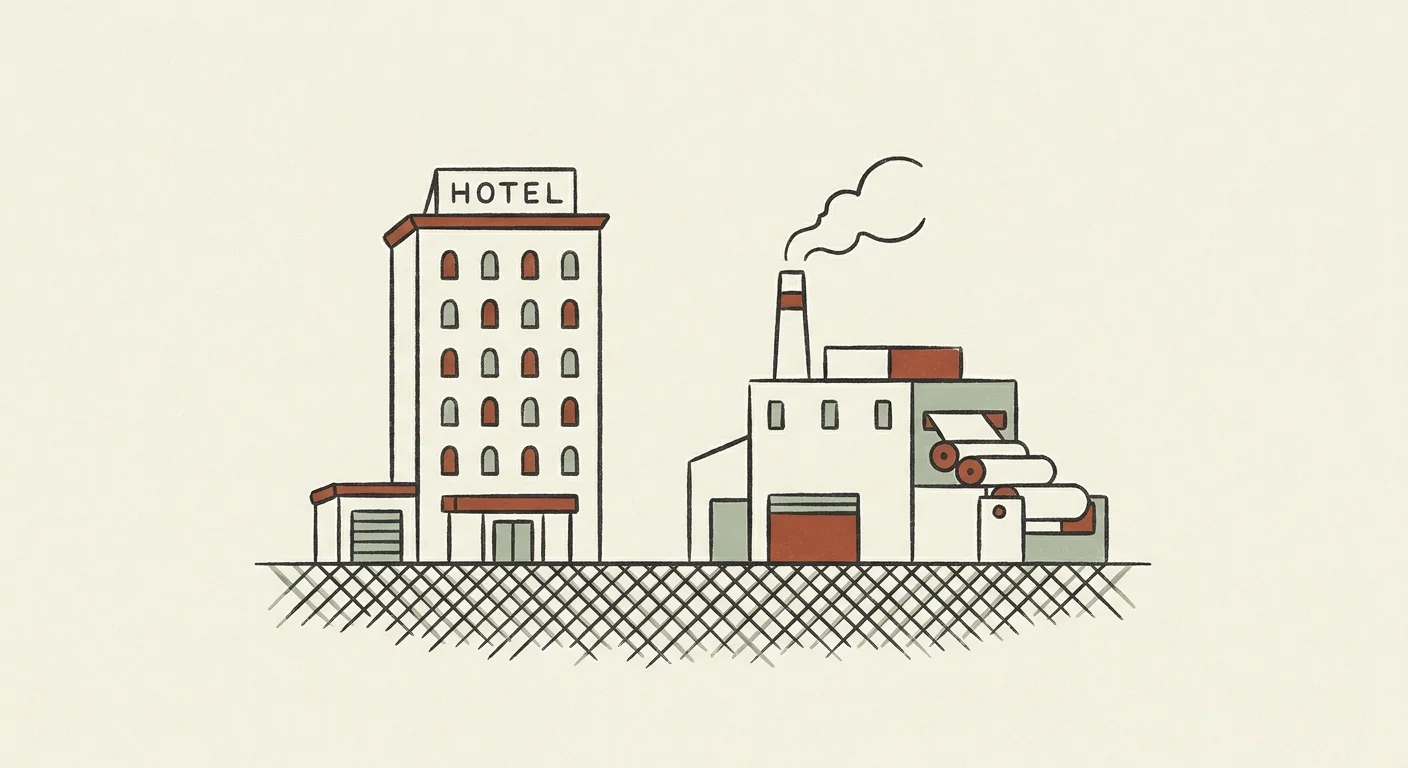
It is fair to be skeptical of any platform that claims to work everywhere. "Vertical-agnostic" usually means "vague," a product so general it does nothing well. So let us be concrete, with two operations that genuinely have nothing in common on the surface, and show why one operational layer fits both, not by being vague, but by being precise about what is actually shared.
The hotel
A hotel runs on a building. Its systems are HVAC, lighting, access control, occupancy sensors, the property management system that knows who is arriving and who is checking out. The work is keeping the place comfortable and efficient while the rhythm of guests rises and falls through the day. Cool the rooms before afternoon check-in. Don't heat an empty wing. Make sure the late arrival's keycard works the moment they reach the door.
The paper company
A paper-and-print company runs on orders. Its systems are an order pipeline, a proofing and approval flow, production schedules, and the carriers that move finished goods. The work is making sure what was promised actually ships on time. A proof stuck in approval. A run that will miss its press window. An order that is going to slip past its promised date while everyone assumes it is fine. The customer should hear about a delay from you, before they have to ask.
Two operations with no vendor, building, or customer in common. And yet, watch what the work actually is, and the difference dissolves.
Read that table top to bottom and the two columns are the same operation wearing different clothes. Sense the real state of things across siloed systems. Reason about what is happening and what is coming. Act through the systems you already have, safely, leaving a record. That loop is invariant. The hotel's HVAC and the paper company's carrier feed are just different inputs to the same machine.
What the platform shares, and what it doesn't
The reference architecture aims to reuse a sense-reason-act contract, policy gates, duplicate controls, and supported execution records across verticals. The generalized kernel is managed early access, and pricing shown on the site is indicative rather than a claim that a production platform is free.
The part that differs is the integrations and operators, and Fibric is deliberate about keeping that the only thing that differs. A connector teaches Fibric to talk to a specific system: a building's HVAC controller, an order pipeline, a proofing tool. An operator is a named worker that runs a specific operation: comfort and energy for the hotel, at-risk orders for the paper company. You assemble the operation you have from the marketplace. You do not get handed a different product.
- Capability over connector. A stable capability contract can reduce rewrite work, provided the replacement connector proves semantic and policy parity.
- Examples show intended reach. BearScope is live; hotel, warehouse, and other physical examples are reference patterns unless explicitly labeled otherwise.
- Reuse existing systems where feasible. Hardware, gateways, network segmentation, or commissioning may still be required.
Why this matters for what you run
You probably do not run a hotel or a paper company. You run something else, with its own systems, its own promises, its own afternoon overheating problem of one kind or another. The reason these two examples are worth your time is that if the loop fits operations this different, it almost certainly fits yours. The question is never "is there a Fibric for my vertical." There is one Fibric. The question is which systems you connect and which operators you point at the outcome you care about.
One operational layer, for anything you run. The hotel and the paper company are simply where we can show it most clearly.
Keep reading: The 657-message problem · Neuro-symbolic root-cause