The dashboard didn’t fix anything
Operations teams spent a decade building the best rear-view mirror in the history of business. Every metric, every anomaly, every breach of every threshold, rendered beautifully, seconds after it happened. And the operation itself behaved exactly as it did before.
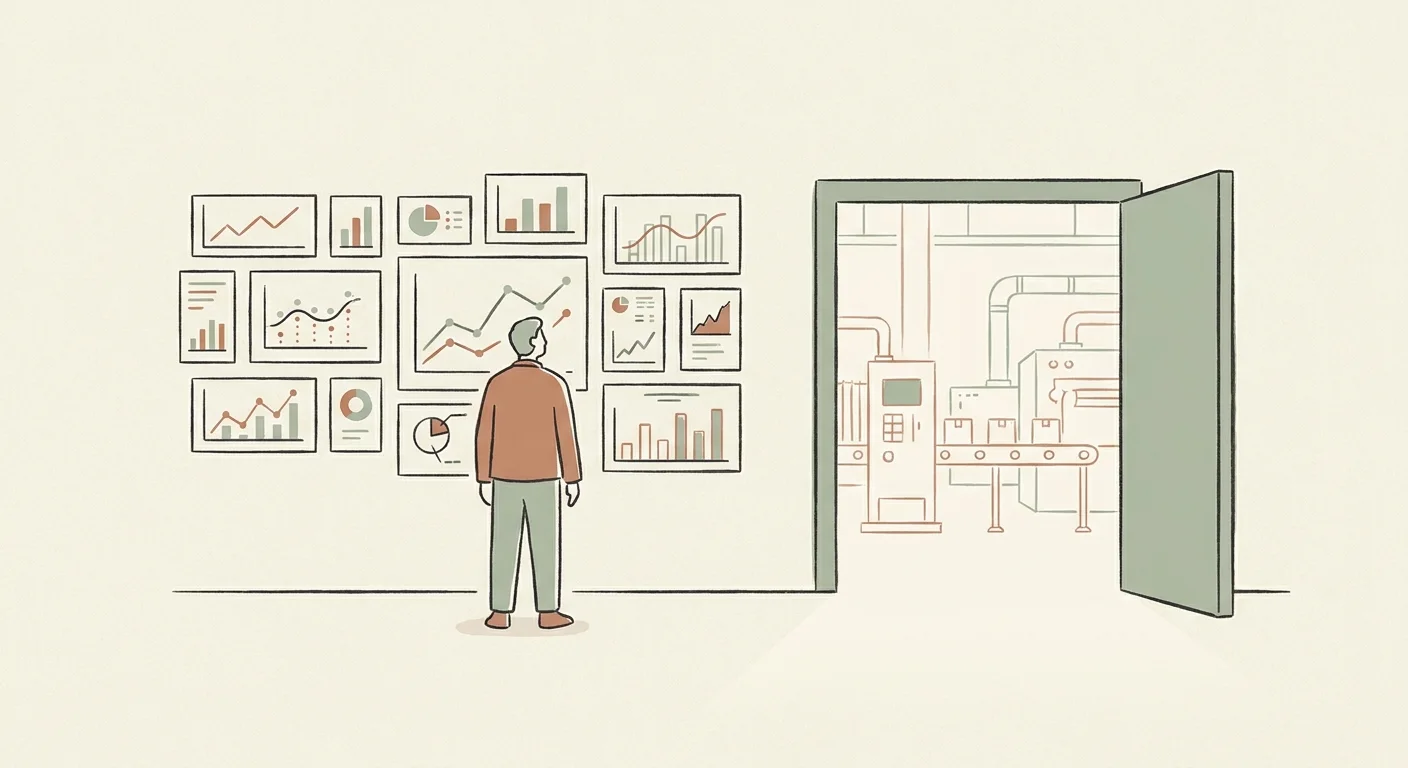
The business intelligence era kept its promises. Warehouses, contact centers, storefronts, and buildings that ran on gut feel in 2010 now run on instrumented truth. The data is clean, the pipelines are real-time, the charts refresh before the meeting starts. If your operational problem was not knowing, that problem has been solved, thoroughly and at industrial scale.
So why do the operations underneath those dashboards still leak the same money in the same places? Ask any operator to walk you through their screens and you will hear a peculiar grammar: this chart shows where we lose margin, that one shows which queue breaches SLA, this alert fires when a threshold trips. Shows. Fires. Breaches. It is all the vocabulary of witness, none of it the vocabulary of intervention. The dashboard sees everything and touches nothing.
The last meter
Between a system that knows and a system that is fixed, there is a short, brutal distance we think of as the last meter. It is the meter between the alert and the API call. Between the chart that says a refund is stuck and the hand that unsticks it. Between the sensor that reads an empty conference room at 24 degrees and the setpoint that stops heating it. Every dashboard ever built stops one meter short of the thing it measures, and hands that meter to a person.
And people, reasonably, do not scale into that meter. Crossing it means context-switching into some system of record, holding policy in your head, acting under time pressure, and doing it again forty times before lunch. The industry's answer was to hire coordinators, write runbooks, and set up escalation rotas: an expensive human transmission bolted between the analytics engine and the operation. When people say their teams suffer alert fatigue, this is what they mean. The alert was never the product. The action was, and the alert was as far as the software could go.
Why the meter stayed uncrossed
It is worth being fair about why software stopped at the glass for so long. Writing to production systems is categorically different from reading them. A dashboard that renders a wrong number embarrasses you; a system that issues a wrong refund, reroutes a wrong shipment, or unlocks a wrong door damages you. Absent a real answer to what if it acts badly, staying read-only was the correct engineering decision, and a generation of vendors made it. The gap persisted not because nobody noticed it, but because nobody could cross it responsibly.
That is also why the current wave of "just let the model call the tools" agents should worry anyone who runs a real operation. They cross the meter by ignoring what made it dangerous. An unbounded, non-deterministic system wired straight to production write paths is not the solution to the operations gap. It is the incident report waiting for a timestamp.
Crossing it with governance
The reference architecture crosses that meter with a separation between proposal, policy, and bounded execution. Single-flight, idempotency, and execution records can reduce common risks on governed paths; they do not eliminate external ambiguity, independent writers, or incomplete policy.
BearScope is live on governed CX and commerce data, through its current application BFF. The generalized kernel and Smart City Labs hotel pattern remain managed early access or illustrative. They share a control vocabulary, not a proven identical production runtime.
What to keep, what to retire
None of this makes the decade of BI wasted. The pipelines, the instrumentation, the hard-won semantic agreement about what a metric means: all of that is the sensory system an acting platform requires, and teams that invested in it are the ones best positioned now. What deserves retirement is the assumption baked into every one of those screens, that the job of software is to inform a human who will then go do the work. Measure your tooling by a harder standard: not what it can show you, but what it can safely do about it. Hindsight is finished. It was never the hard part.
Keep reading: AI must leave the screen · Where seconds compound